You Won’t Believe These Hidden Photo Spots in Sukhothai’s Wild
Sukhothai, the cradle of Thai civilization, isn’t just about ancient temples. Beyond the ruins lies a world of untouched natural beauty—lush wetlands, lotus-filled lakes, and golden sunrise views over misty rice fields. I went searching for the real soul of this UNESCO site and found photo spots so stunning, they felt like secrets. If you’re chasing authentic, frame-worthy moments in nature, Sukhothai delivers in ways no one talks about. This is not merely a destination for history lovers; it’s a sanctuary for those who seek quiet wonder, poetic light, and landscapes where time slows down. Here, nature doesn’t compete with heritage—it completes it.
Why Sukhothai’s Natural Side Stole My Heart
When most travelers think of Sukhothai, they picture the iconic silhouette of Wat Mahathat at dawn, its lotus-bud chedis rising from a sea of morning mist. And yes, that view is unforgettable. But what few realize is that the true magic of Sukhothai extends far beyond the temple walls. It lives in the stillness between the ruins, in the soft rustle of rice stalks swaying in the breeze, and in the quiet reflection of lotus blossoms floating on glassy ponds. My first visit was meant to be a historical pilgrimage, yet it became something deeper—an immersion into a landscape where nature and culture coexist in harmonious balance.
What surprised me most was how effortlessly the natural world embraces the ancient city. Vines curl around weathered stones, birds call from treetops above crumbling cloisters, and sunlight filters through the canopy in golden beams that feel almost sacred. This blend of serenity and history creates photographic opportunities unlike any other. Unlike crowded urban temples or heavily touristed ruins, Sukhothai’s countryside offers space—room to breathe, to observe, and to connect. It invites photographers not just to document, but to feel.
For women in their thirties to fifties, many of whom balance family, work, and personal well-being, Sukhothai offers a rare gift: stillness. There is something deeply nourishing about standing alone in a rice field as the sun rises, camera in hand, heart full. The pace here mirrors a slower, more intentional way of living—one that resonates with those seeking meaning beyond the everyday. And for those who carry a camera, whether professional or simply a smartphone, the rewards are endless. Every turn reveals a new composition, a fresh perspective, a moment waiting to be preserved.
The real soul of Sukhothai isn’t locked behind museum glass. It’s alive—in the wetlands, in the fields, in the quiet corners where few footsteps fall. To experience it is to fall in love not just with a place, but with the act of seeing itself.
Sunrise at the Lotus Pond – A Moment Frozen in Time
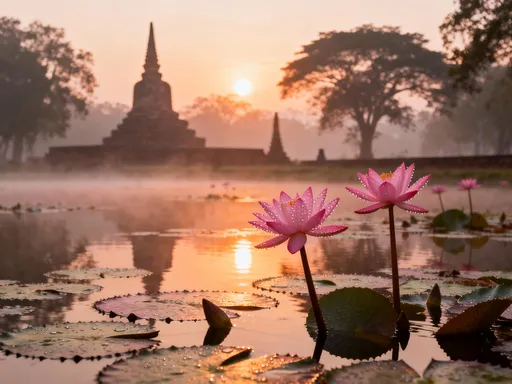
One morning, long before the sun cleared the horizon, I found myself crouched at the edge of a secluded lotus pond just outside the main park zone. The air was cool and damp, carrying the faint scent of water lilies and earth. The surface of the pond was perfectly still, like polished glass, reflecting the pale pink and lavender hues of the waking sky. As light spilled over the treetops, the first golden rays touched the tips of blooming lotuses, their petals opening like hands in prayer. In that moment, time seemed to stop. It was not just beautiful—it was transcendent.
This hidden pond, known locally but rarely marked on tourist maps, is one of Sukhothai’s best-kept secrets. Unlike the more popular temple ponds, which can draw small crowds for sunrise, this one remains quiet, visited mostly by local birdwatchers and the occasional monk on morning alms rounds. The solitude enhances the experience, allowing for full immersion in the scene. For photographers, the conditions are ideal: soft, diffused light, rich color contrasts, and natural symmetry in the water’s reflection.
To capture the best images here, timing is essential. Arriving 45 minutes before sunrise ensures you’re settled and ready as the light evolves. A tripod is highly recommended, especially for long exposures that capture the mirror-like surface without blur. Use a polarizing filter to reduce glare and enhance the deep greens of the lotus pads. A mid-range aperture (f/8 to f/11) will keep both foreground blooms and distant trees in focus, while a low ISO preserves image clarity in low light.
But beyond the technical details, what matters most is presence. This is not a place for rushed shots or checklist tourism. It’s a space for mindfulness. Sit quietly. Watch how the light moves. Wait for the kingfisher that darts across the water or the dragonfly that lands on a petal. These fleeting moments often make the most powerful images—not because they’re perfectly composed, but because they carry emotion. The lotus pond teaches patience, and in return, it offers beauty that feels almost sacred.
Walking Through Golden Fields – Where History Meets Harvest
During the dry season, particularly from November to January, the countryside surrounding Sukhothai transforms into a sea of gold. Vast rice fields stretch in every direction, their ripened stalks glowing under the open sky. What makes this landscape truly extraordinary is the way it frames the ancient temples. From certain vantage points, you can capture the spires of Wat Si Chum or Wat Saphan Hin rising above the golden waves, as if the past and present are sharing the same breath.
These fields are not just scenic—they are living. Farmers work the land with the same rhythms that have defined this region for centuries. The harvest is a communal effort, with families gathering at dawn to cut, bundle, and carry the rice by hand. There’s a dignity in this labor, a connection to the earth that feels both humble and profound. For photographers, these scenes offer rich storytelling potential. A wide-angle lens can capture the expanse of the field with a temple in the distance, while a telephoto lens can isolate a farmer’s weathered hands or a child helping to stack sheaves under the sun.
The best light for photographing the rice fields occurs during the golden hours—shortly after sunrise and before sunset. At these times, the low angle of the sun casts long shadows and warms the entire landscape, enhancing the golden tones. Backlighting can create a glowing effect, making the rice stalks appear to shimmer. For a more dramatic look, try shooting into the sun with a lens hood to prevent flare, or use exposure compensation to avoid overexposing the bright highlights.
What makes these fields so emotionally resonant is their impermanence. Within weeks of harvest, the golden sea is gone, replaced by plowed earth or flooded paddies. This transience adds a layer of poignancy to every image. Each photograph becomes a record of a fleeting moment—a season, a harvest, a way of life that continues quietly, far from the noise of modern tourism. For women who value tradition, family, and the quiet strength of everyday life, these fields speak volumes.
Khlong Suan Pa – The Wetland Escape Few Know About
Nestled in the northern outskirts of the historical park, Khlong Suan Pa is a wetland area that remains largely overlooked by mainstream tourism. This quiet expanse of marshland, crisscrossed by wooden walkways and dotted with lotus ponds, is a haven for birdlife and a dream for nature photographers. Herons stalk the shallows, egrets take flight at the sound of footsteps, and kingfishers flash like blue sparks through the reeds. The air hums with the sound of dragonflies and frogs, creating a soundtrack of pure wilderness.
What sets Khlong Suan Pa apart is its seasonal transformation. During the rainy months, from August to October, the area floods, turning the trails into floating paths above submerged grasslands. The water reflects the sky in shifting shades of gray and silver, creating surreal mirror images. In drier periods, the marshes recede, revealing mudflats where birds forage and lotus pads cluster in shrinking pools. Each season offers a different mood, a different palette.
Photographers will appreciate the variety of compositions available here. Close-up shots of water droplets on lily pads, wide-angle views of the flooded trails vanishing into mist, or slow shutter captures of birds in flight—all are possible. A macro lens can reveal the intricate patterns on a dragonfly’s wing, while a telephoto lens allows for discreet wildlife photography without disturbance. Because the area is rarely crowded, you can move at your own pace, pausing to watch a turtle slide into the water or a spider weave its web between reeds.
Responsible visitation is key. The wooden walkways are there to protect the fragile ecosystem, so staying on the path is essential. Avoid loud noises, sudden movements, or attempts to feed the animals. This is not a zoo—it’s a living habitat. By respecting the space, visitors help ensure it remains a sanctuary for both wildlife and quiet reflection. For those seeking solitude, beauty, and a deeper connection with nature, Khlong Suan Pa is a treasure worth discovering.
Forest Trails Behind the Temples – Nature Reclaiming History
Behind the more famous temples of Sukhothai, a network of shaded forest trails winds through the green heart of the historical park. These paths are less traveled, often bypassed by tour groups in favor of the central monuments. But for those willing to wander off the main route, they offer some of the most powerful imagery in the entire site. Here, nature is not just present—it is actively reclaiming the past. Tree roots snake over stone foundations, moss blankets forgotten stupas, and fig trees grow from the roofs of ancient viharas, their roots cascading like stone waterfalls.
One of the most striking examples is a small, unnamed shrine deep in the northern woods, where a massive banyan tree has enveloped a stone Buddha niche. The roots wrap around the structure like fingers, holding it gently but firmly. Sunlight filters through the canopy in dappled patterns, illuminating patches of emerald moss and lichen. The air is cool and still, carrying the scent of damp earth and leaves. It’s a scene that feels both ancient and alive—a perfect metaphor for the passage of time and the resilience of nature.
Photographing these spaces requires attention to light and composition. The dense canopy creates high contrast, so it’s important to expose for the shadows to retain detail. A polarizing filter can help reduce glare on wet surfaces after rain. To capture the scale of the trees and ruins, use a wide-angle lens and position yourself low to emphasize height and depth. For more intimate shots, a standard or macro lens can highlight textures—the roughness of bark, the softness of moss, the precision of ancient stonework now softened by time.
Footwear matters on these trails. The ground can be uneven, slippery after rain, or covered in roots and loose stones. Sturdy walking shoes with good grip are recommended. Visit in the mid-morning or early afternoon when the sun is higher and more light penetrates the trees. Early morning fog can add atmosphere, but may limit visibility. These trails are not just for photography—they are for contemplation. They invite you to slow down, to notice, to reflect on the quiet power of nature’s reclamation.
Seasonal Magic – When and Where Nature Shines Brightest
To experience Sukhothai’s wild beauty at its peak, timing is everything. The region’s climate shapes not only the landscape but also the photographic opportunities available throughout the year. Each season brings a distinct character, a unique palette, and its own quiet wonders.
The lotus bloom season, from May to July, is one of the most photogenic periods. As the rains begin to fill the ponds and marshes, lotus flowers emerge in vibrant pink and white, floating serenely on the water. The early morning light enhances their delicate colors, and the stillness of the wetlands creates perfect reflections. This is the ideal time to visit the smaller, lesser-known ponds and canals around the park, where the blooms are abundant and the crowds are thin.
From November to January, the harvest season transforms the countryside into a golden expanse. The rice fields, fully ripened, glow under the clear winter sky. Mornings are crisp, with light mist rising from the paddies, while evenings offer long, warm sunsets that bathe the temples in soft amber light. This is also one of the most comfortable times to visit, with cooler temperatures and low humidity.
The green season, from August to October, is often overlooked but holds its own magic. After the rains, the landscape is lush and vibrant. Flooded fields reflect the sky, creating mirror-like surfaces perfect for abstract compositions. The air is fresh, the greens are intense, and the light is soft and diffused, ideal for photography without harsh shadows. While occasional downpours may occur, they are usually brief, followed by clearing skies and dramatic cloudscapes.
Regardless of the season, preparation enhances the experience. Bring a light rain jacket during the wet months, wear layers in winter, and always carry water and sun protection. A small notebook to jot down observations or a journal entry can deepen your connection to the place. By aligning your visit with the natural rhythms of the land, you don’t just see Sukhothai—you feel it.
How to Capture Sukhothai’s Wild Beauty – A Photographer’s Mindset
Photographing Sukhothai’s hidden landscapes is not just about technical skill—it’s about intention. The most powerful images come not from the fastest shutter or the sharpest lens, but from a moment of genuine connection. To truly capture the spirit of this place, slow down. Put the camera down sometimes. Breathe in the scent of wet earth, listen to the call of a distant bird, feel the morning chill on your skin. These sensations inform your photography, giving it depth and authenticity.
Pay attention to light. It changes everything. The same pond can look flat at noon but magical at dawn. Learn to read its moods—how it slants through trees, dances on water, or gilds the edge of a rice stalk. Move with it. Return to the same spot at different times. You’ll be surprised how a place can transform.
Respect is just as important as observation. This is not just a backdrop for photos—it’s a living landscape, home to wildlife, farmers, and local communities. Stay on marked paths, avoid disturbing animals, and never remove plants or artifacts. Photography should leave no trace but the image itself.
And finally, remember why you’re here. For many women in midlife, travel is more than escape—it’s renewal. It’s a chance to reconnect with creativity, curiosity, and quiet joy. Sukhothai offers that in abundance. Its wild beauty doesn’t shout; it whispers. It doesn’t dazzle; it reveals itself slowly, to those who are willing to look.
So go gently. Shoot mindfully. Share what you see, but also carry the feeling home. Sukhothai is not just a destination. It’s a reminder that wonder still exists—in the mist over a rice field, in the bloom of a lotus, in the quiet space between heartbeats. And sometimes, the most powerful photographs are the ones we keep in our hearts.